
Concert Preparation for Choirs: Your Plan for the Perfect Performance
February 2, 2026
•

Janina Moeller
Choir director since 2010A successful choir concert is the result of months of careful planning and intensive rehearsal work. Whether it's a Christmas concert, a summer performance or an ambitious a cappella project – the right preparation makes the difference between a good and an unforgettable performance. In this guide I'll show you how to shape your choir concert professionally, from the first idea to the final applause.
The Fundamentals of Concert Planning
Choosing the Right Programme
A well-thought-out programme is the foundation of a successful concert. Take various factors into account:
Level and line-up: Choose pieces that challenge your choir but don't overwhelm it. Developmental psychology knows this principle as the "zone of proximal development" described by Lev Vygotsky: learning works best when the material sits just above your current ability – reachable with the right support, but not manageable on your own. Choral educators like Dr Brandon Hopkins apply this principle deliberately when choosing repertoire and recommend picking pieces that stretch the singers just enough to keep them motivated without frustrating them. At the same time: if a particularly demanding piece is on the programme, there's room for an easier work too – a breather in between does the choir good.
Create variety: A good concert programme is like a journey with highs and lows. Alternate between different eras, languages and moods. An a cappella piece follows one with piano accompaniment; an energetic gospel number sits opposite a meditative madrigal. One thing matters here: the changes mustn't be too abrupt. Building and releasing tension needs to be shaped deliberately – jarring breaks are more likely to confuse the audience than to thrill them.
Audience engagement: Think about your audience. A mix of familiar melodies and surprising discoveries keeps attention high. Many successful choir directors follow the 70-30 rule: 70% accessible pieces, 30% demanding or experimental ones.
Efficient Rehearsal Design
Scheduling: When Does Preparation Start?
The rule of thumb is: the more demanding the programme, the earlier you should start. Exactly how much lead time you need depends on many factors – your choir's level, the number of new pieces, the length of the programme and how often you rehearse. Large projects with orchestra or staged elements can need six to twelve months of lead time.
I still remember our first Christmas Oratorio well – we started far too late and the last few weeks were pure stress. Ever since, with bigger projects I'd rather start a month too early than a day too late.
For orientation – a rough schedule:
For a concert where most of the pieces are already familiar and only need refreshing, around 16 weeks of lead time can be enough. If the programme consists mostly or entirely of new works, however, you should count on at least 10 months of preparation, depending on length and difficulty. In any case, plan enough buffer – unforeseen cancelled rehearsals or gaps caused by illness happen more often than you'd think.
Structured Rehearsal Planning
A clear rehearsal structure is crucial for progress. Set concrete goals for every rehearsal and communicate them to your choir members in advance.
A proven rehearsal structure:
- Warm-up (10-15 minutes): not just warming up, but targeted training
- Repeating familiar passages (20-30 minutes): consolidation and fine-tuning
- Working on new sections (30-40 minutes): make use of peak concentration
- Run-through and feedback (15-20 minutes): develop the overall picture
One tip I've learned over the years: after every rehearsal, write down three bullet points – what went well, what didn't, what's coming next. It sounds trivial, but after twelve weeks of rehearsals you'll be glad you can flick back and see where the choir started.
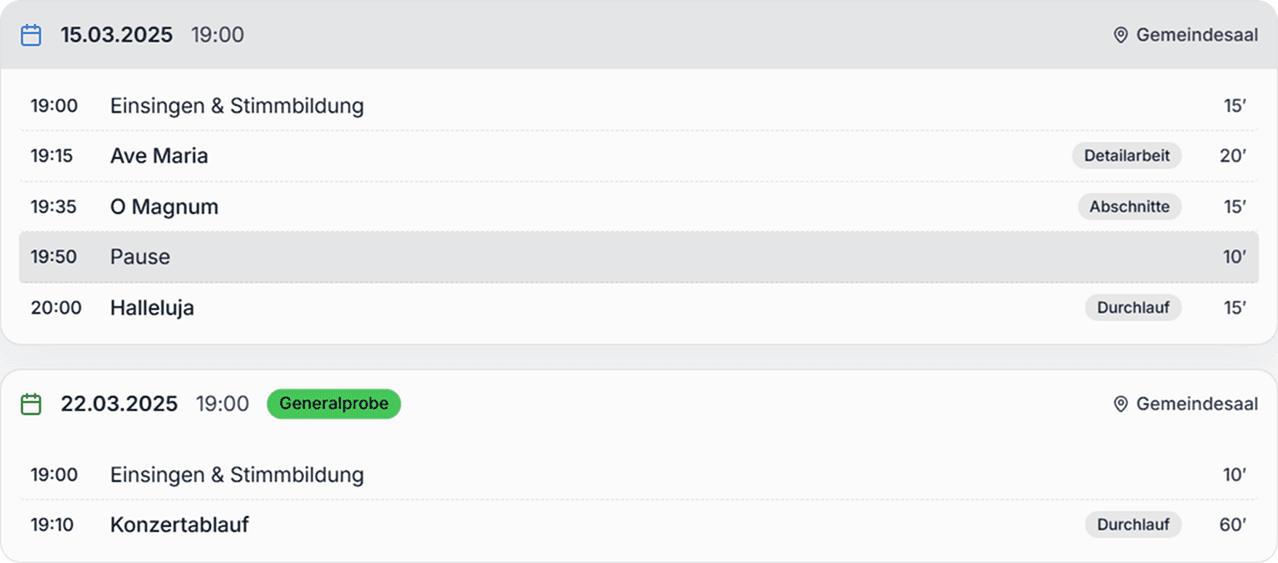
For less experienced choir directors in particular, rehearsal planning can feel overwhelming at first. How much time does which piece need? In what order should the works be learned? Which exercises suit which problems best? This is where digital tools can offer valuable support. Tools such as the free rehearsal plan generator from cori help you build structured rehearsal plans tailored to your specific needs. The big advantage: the finished plan can be shared directly with all choir members, so everyone knows what's on the programme for the next rehearsal and can prepare accordingly.
Digital support can work wonders here too. Modern choir apps like cori let singers prepare for rehearsals better at home. That means less rehearsal time spent on simply learning the notes and more time for the musical work. I've written about what apps like this can do here and here.
Individual Voice Work and Sectional Rehearsals
The closer the concert gets, the more important the detailed work becomes. Sectional rehearsals, where each voice part can work on its own line separately, are extremely valuable – even if they aren't always feasible in practice. If you can, schedule at least a few such sessions, because they create confidence and precision.
Tips for effective individual voice work:
- Provide practice recordings (isolated voice parts)
- Encourage independent practice with a metronome or SingAlong/TeachMe tracks
- Set up practice-partner tandems within the voice parts
Good practice recordings are worth their weight in gold – they save an enormous amount of rehearsal time because the notes are already secure and you can work directly on expression and dynamics. Particularly handy if you use a choir app: with an audio mixer, singers can turn their own voice up or down and gradually move from guided practice to singing independently within the full sound.
In my choir, the tandem system has also proved especially valuable: we pair experienced singers with newcomers in the same voice part. During our last concert project, a new tenor told me that thanks to his tandem partner he felt for the first time that he really understood a difficult passage, instead of just going with the flow.
Technical and Organisational Preparation
Venue and Acoustics
The venue makes an enormous difference. Visit potential performance spaces in person and do a sound test. Important factors:
Room acoustics: A reverberation time of 1.5 to 2.5 seconds is ideal for choral music. When in doubt, a fairly dry room is better than one with too much reverb – with dry acoustics, technology can still work wonders, while excessive reverb washes out the intelligibility of the text irreversibly.
Stage size: Calculate at least 0.8 to 1 square metre per singer. A 40-strong choir therefore needs around 40 square metres of stage area for a comfortable set-up.
Technical equipment: Clarify in advance what equipment is available and what you need to bring. Checklist:
- Microphones (if required)
- Lighting (spotlights, stand lighting for the conductor)
- Conductor's podium if needed
- Piano tuning (if needed)
- Amplification for soloists
We once had a performance in a beautiful old church – the sound was fantastic, but nobody had thought about the fact that there were no power sockets near the stage. The pianist sat in the dark until someone rustled up a 30-metre extension cable from the parish hall. Ever since, "check the power" has been right at the top of my venue checklist.
Stage Layout and Sightlines
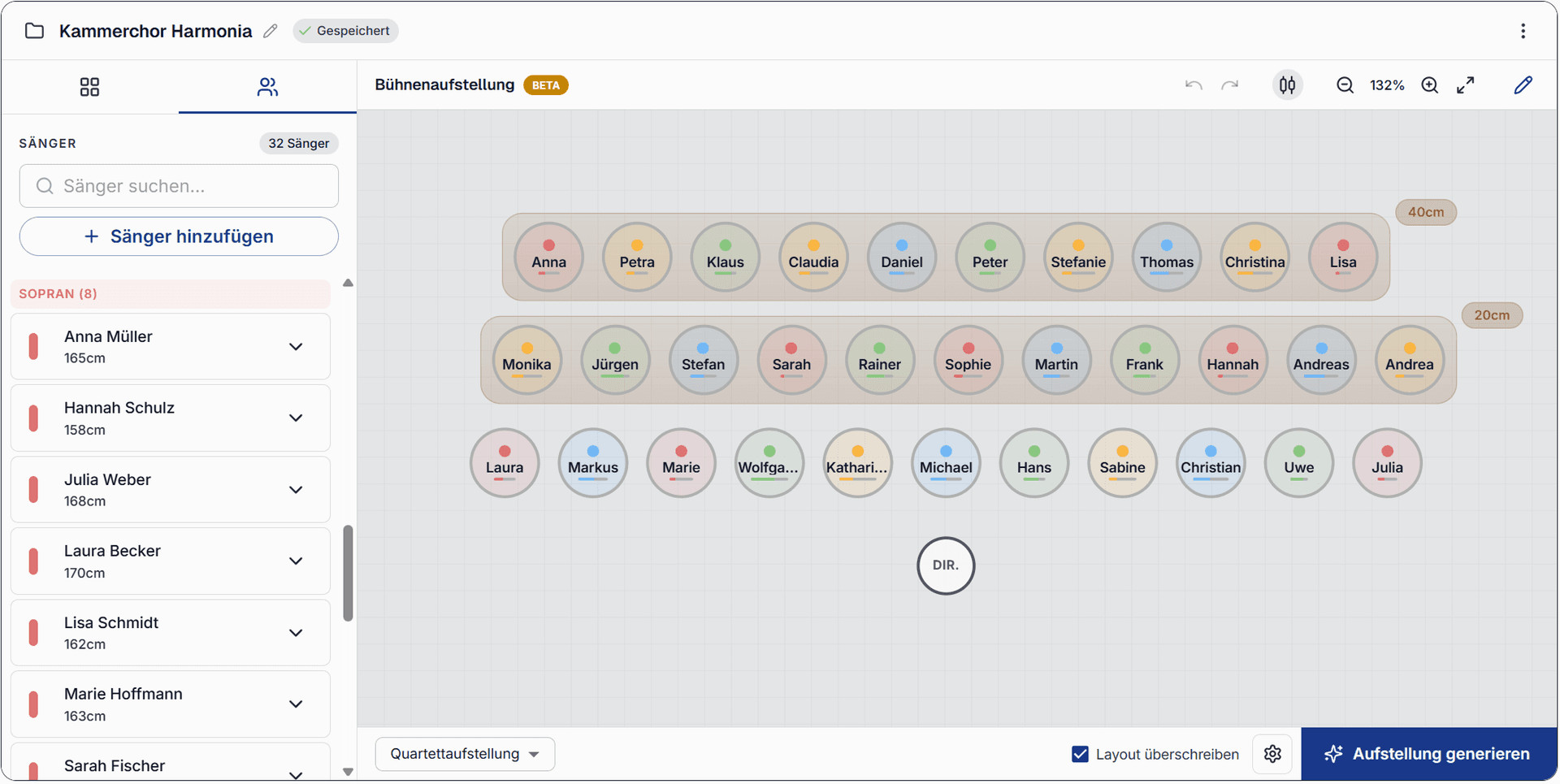
Where people stand on stage influences both the sound and the visual impact. Experiment with different layouts in the weeks before the concert:
Classic layouts:
- Semicircle: ideal for smaller choirs (up to 30 people), encourages eye contact
- Staggered rows: standard for larger ensembles, gives a balanced sound
- Voice-part blocks: allows precise ensemble within the voice parts
If you want to visualise and try out different variants quickly, take a look at the free choir layout planner from cori – the tool generates suitable layout suggestions based on your choir's line-up, which you can adjust directly and share with your choir (currently in beta).
Make sure all singers can see both the conductor and any instrumentalists. Taller singers shouldn't block the view of shorter choir members.
Psychological Preparation
Turning Stage Fright to Your Advantage
Even experienced choir singers know that queasy feeling before a performance. The key is turning the nervousness into positive energy.
Proven strategies against stage fright:
- Breathing techniques: deep abdominal breathing calms the nervous system
- Visualisation: picture a successful performance
- Rituals: shared warm-up rituals create confidence
- Positive self-talk: replace "I hope nothing goes wrong" with "I'm well prepared"
At my very first concert as a choir director, my stage fright was so strong that my hands were shaking. An experienced colleague told me back then: "If you're not nervous, it isn't important enough to you." That helped me see the excitement as something positive – and in fact the concert was one of the best.
This matches the so-called Yerkes-Dodson law, one of the best-known principles in performance psychology: as early as 1908, the psychologists Robert Yerkes and John Dodson showed that moderate arousal improves performance – too little tension leads to indifference, too much to freezing up. For choir singers that means: a healthy amount of stage fright isn't an enemy, it's an ally.
Mental Preparation and Focus
In the days before the concert, the focus should be on mental preparation. Avoid intensive learning of new material in this phase. Instead:
- Do relaxed run-throughs
- Concentrate on interpretation and expression
- Create a positive group dynamic
- Clear up any last organisational questions
A shared ritual before the performance – whether that's a chat in a circle, a minute of silence or a joint warm-up – can work wonders for team spirit. In my choir we have the tradition that everyone stands in a circle before the performance, puts their hands on their neighbour's shoulders and takes three deep breaths together. It takes less than thirty seconds, but it noticeably changes the energy in the room.
Dress Rehearsals: The Key to Success
How Many and How to Shape Them
Plan at least two to three dress rehearsals. The first should take place around two weeks before the concert, the final dress rehearsal ideally 24-48 hours before the performance.
First dress rehearsal: Focus on the running order, entrances and exits, transitions between the pieces. Mistakes are still allowed here – they're important learning moments.
Technical dress rehearsal: If possible at the venue, with the full technical set-up. Test acoustics, lighting and all practical procedures.
Final dress rehearsal: A run-through like the real concert, but without excessive pressure. The aim is to gain confidence and clear up any last uncertainties.
What to Do When Things Go Wrong?
Prepare your choir for possible problems too. What happens if:
- Someone misses an entry?
- The technology fails?
- A singer suddenly drops out?
Clear agreements create calm. Many successful choir directors deliberately practise "emergency scenarios" in rehearsals to strengthen the ensemble's flexibility and ability to improvise. I do this occasionally by changing the tempo in the middle of a piece or asking a voice part to sing more quietly, as if two people were missing. At first there are puzzled looks, but by now the choir reacts to surprises far more calmly – in concert as well.
Communication and Coordination
Marketing and Attracting an Audience
A brilliantly prepared concert isn't much use if nobody comes. Start the publicity work at least six to eight weeks in advance, ideally right away.
Online presence: Use social media, your website and newsletters. Share glimpses of the rehearsal work, short video snippets or preview recordings.
Traditional advertising: Posters, flyers and press releases to local media remain effective, especially for an older target audience.
Personal invitations: Encourage every choir singer to extend at least five personal invitations. Word of mouth is often more effective than any advertising campaign. A member of my choir once joked: "I always invite ten people and tell them the concert is sold out – then they really want to come." You don't have to go quite that far, but a bit of enthusiasm in the invitation works wonders.
The Day of the Concert
Time Management on Concert Day
Plan the day in a structured way and avoid rushing:
6-8 hours before: A light, healthy meal. Avoid dairy products (they can leave the voice phlegmy) and heavy food.
3-4 hours before: Travel to the venue, set up, prepare clothing.
90 minutes before: Warm up together, but don't overdo it. The voice should be warmed up, but not tired.
60 minutes before: Final technical checks, costume check, mental preparation.
30 minutes before: Stay calm, get into a positive frame of mind, perhaps a shared ritual.
Stage Performance and Presence
Musical quality is only one part of the overall experience. Your stage presence contributes significantly to the impact:
Posture: Upright, but not tense. Feet hip-width apart, weight evenly distributed.
Facial expression: Match your expression to the piece. A lively expression carries emotion to the audience.
Eye contact: Look into the audience occasionally, not only at the conductor or at the sheet music.
Concentration right to the end: The performance is only over once the last note has faded and you've left the stage.
After the Concert: Reflection and Development
Using Feedback Constructively
Gather feedback after the concert – from the audience, from the choir members and from outside observers. What went well? Where is there room for improvement?
Important: don't take criticism personally, take it as a chance to develop. The best choirs are the ones that keep learning and improving.
Why Documentation Matters
Record your key insights:
- What worked particularly well in the preparation?
- Which parts of the schedule were realistic and which weren't?
- Which organisational processes should be optimised?
- What technical or spatial challenges came up?
This documentation is worth its weight in gold for your next concert. Many experienced choir directors keep a "concert diary" in which they record their observations and learnings. I use a simple notes app for this and write down my impressions right after the concert – usually still in the car in the car park. The next day you already see a lot of it through rose-tinted glasses, so it's better to do it straight away.
Digital Tools for Modern Choir Work
Digitalisation has changed the choral world. What used to mean laborious sheet music distribution and a confusing pile of paper slips can now be solved elegantly and digitally.
Advantages of digital choir management systems:
- Central sheet music management: all choir members have access to the current sheet music at any time
- Practice files for home: singers can practise independently more effectively and arrive at rehearsals prepared. Modern apps even give real-time feedback on pitch and rhythm
- Notes and markings: your own annotations on pieces no longer get lost and are always to hand
- A clear calendar: rehearsals, performances and sectional rehearsals at a glance – including automatic reminders
- Attendance management: who's coming to the next rehearsal? That lets you plan better and know early on whether important voices will be missing
- Repertoire database: all your sheet music organised and searchable
A specialised solution like cori was developed for exactly these needs. Instead of juggling different apps and scraps of paper, you have everything in one place – from sheet music management to integrated practice features and the rehearsal calendar.
The nice thing about it: while you as choir director keep the overview, your singers can pull up their sheet music, check dates and practise their part. That saves time, reduces stress and leaves more room for what it's really about – the music.
Conclusion: Your Path to an Unforgettable Concert
Preparing a choir concert goes far beyond simply learning the notes. From choosing the programme and shaping the rehearsals through to technical details and psychological preparation – every aspect contributes to the overall success.
The most important success factors in summary:
- Timely, structured planning (depending on repertoire and the choir's level)
- A well-considered programme chosen with both choir and audience in mind
- Efficient rehearsal design with clear goals
- Mental preparation and a constructive approach to stage fright
- Clear communication and good coordination
- Using modern tools to simplify administrative tasks
A successful concert is the result of teamwork, discipline and passion. With the right preparation and a structured approach, your performance won't just convince musically – it will touch your audience emotionally and inspire them long afterwards.
Get your choir ready for the future
So you can concentrate on what matters most: the music.
Share this article
More Articles

Choir Apps 2026 Compared
Choir apps 2026 compared: from Konzertmeister to cori – which app fits your choir? An honest review with clear recommendations for organization and practice.

The 6K practice room for the 2027 season: now in the browser too
6K UNITED! has opened the 2027 season, and cori's 6K practice room is ready: every song with chapter markers, follow-along lyrics and sheet music, groups and appointments for teachers, and for the first time in the browser as well, with nothing to install. What's new and how you get started.