
Ticketing for choirs: sell concert tickets online without a base fee
July 7, 2026
•

Jonas Deuchler
Founder, coriYour choir spends months preparing a concert. You learn the parts, polish the sound, plan the programme. And then, two weeks before the performance, someone asks at rehearsal: "Who's actually taking care of the tickets?"
What follows is familiar to most associations: a list of names in a spreadsheet that nobody maintains. An envelope of cash the treasurer takes home overnight. And on the night of the concert, the nagging question of whether the 40 people who "definitely" wanted to come will actually turn up.
This can be solved, and better than most choirs think. Ticket sales are only one building block of good concert preparation anyway — but they're the one associations most often overreach on. Because choosing a platform is trickier than it looks: two providers with almost identical fees can differ on whether your money is in your association's bank account on concert day or still sitting with the provider six weeks later. And not a single big ticketing provider answers the questions your treasurer really asks: how does the GEMA registration work? Which tax rate belongs on the invoice? Do we have to take tickets back if someone falls ill?
This guide answers exactly those questions — for choirs, orchestras, music associations and every other group that fills a hall.
Why paper tickets cost your association money
Selling for cash at the door feels free. It isn't.
- You don't know your numbers. How many chairs do you put out? How many programmes do you print? How much sparkling wine do you buy for the reception? Without advance sales you're guessing, and guessing costs money.
- Reservations without payment are not commitments. People who haven't paid are far less likely to turn up when it rains. Paying up front noticeably reduces the number of empty seats.
- Cash creates work after the concert. Counting, reconciling, depositing, booking. That's unpaid volunteer time.
- Your audience stops at your address book. A link can be forwarded in the sopranos' WhatsApp group. A paper flyer can't.
From around 100 tickets per concert, selling by hand becomes a real burden. That's the order of magnitude at which a ticket shop practically always pays for itself.
What a ticket shop really costs
This is where it gets confusing, because almost every provider calculates differently — and because the advertised price is often only half the bill. A ticket fee has two parts:
- The platform fee. That's the number on the provider's pricing page.
- The payment fee. That's what Stripe, PayPal or the card provider take for processing. At many platforms it comes on top separately — and how high it turns out depends on what your guest pays with. You don't decide that, and you only see it in the statement after the concert.
With cori Tickets there is no second, hidden line: 5% + €0.50 per ticket sold is the whole price — every payment fee is already included. Whether your guest pays with a Girocard, an American credit card, by SEPA direct debit or with Klarna: on a €15 ticket you always get exactly €13.75, on a €20 ticket always exactly €18.50. You can work out your concert budget in advance instead of checking it afterwards.
Here's what the same sale looks like side by side:
A few things that matter when you compare:
The fixed fee decides, not the percentage. On a €15 ticket, a fixed fee of €1.79 per ticket (Eventbrite) costs more than the entire percentage share. The cheaper your tickets, the harder every fixed fee hits. For an €8 children's ticket, that's the difference between "acceptable" and "absurd" — and the reason we stuck with €0.50 at cori.
Pay attention to what's included in the plan. A provider's cheapest plan is rarely the one you end up needing. At many platforms, voucher codes, a custom ticket design or payouts before the event only appear in the higher plans, and some entry-level models only apply up to a certain price limit. So don't compare entry-level prices, compare the plans that actually cover the features you need.
You can pass the fee on. With cori you decide per ticket category whether the association bears the fee or whether it's added to the ticket price. A €20 ticket then becomes a €21.50 ticket, and the choir keeps the full €20. Eventbrite even does this by default.
Free tickets cost nothing. A ticket priced at €0 triggers no fee. So you pay nothing for press, sponsors and the soloists' families.
And what do the big names cost? Example calculations for a €15 ticket
For context: the two platforms most associations think of first, in the same example calculation — platform fee plus payment fee.
- Eventbrite: 3.7% + €1.79 plus a 2.9% payment fee — around €2.80 together, and thus more than double cori. Over 200 tickets sold that's a difference of around €310. Payout only after the event; the German pricing page states the fixed fee in US dollars.
- EVENTIM.Light: 3.5% + €0.99, payment fee included — €1.52. Payout only happens once you close out the event after the concert.
And an honest assessment: depending on the plan and on how your audience pays, an individual provider can occasionally come in a few cents below cori on the bare example price — that's usually paid for elsewhere, with a payout weeks after the concert or with payment processing you have to set up and run yourself. So the fee alone rarely decides it — the points in the next sections do.
The most important question: where is your money until the concert?
This is the question no provider answers voluntarily, and for an association it matters more than a 30-cent difference in fees.
If you sell tickets in October for your Christmas concert, a few thousand euros can pile up by December. With EVENTIM.Light, Eventbrite and quite a few other platforms, that money sits with the provider until after the concert.
For an association, that's unpleasant for three reasons:
- You can't put the money to work. The deposit for the hall, the fee for the instrumentalists, printing the sheet music — all of that falls due before the concert. Exactly when your ticket income is somewhere else.
- It's a default risk. Should the provider become insolvent while holding your money, you're one creditor among many.
- The bookkeeping gets imprecise. A single lump transfer six weeks after the concert, bundling 180 individual sales, is far more laborious for the audit than 180 cleanly assigned incoming payments. With a Christmas concert the turn of the year comes on top: if you sell from October to December and the money only arrives in January, the income lands in the wrong financial year — and the annual accounts and the audit get to straighten that out afterwards.
The alternative: a daily payout to your association's account, from the very first ticket sold. That's how cori Tickets works. If you sell in October, the money is with you in October — not in January. Every bit of income belongs to the association from the start, every refund goes out of your balance, and at no point does the provider hold your money. In the organiser area you can see at any time what's already in the account and what's coming in the next few days.
"Our tickets used to run on lists at rehearsal and cash in an envelope. Today we send a link into the WhatsApp groups — and the income is in the association's account before the concert."
— Janina Moeller, Happy Voices
If you ask a ticketing provider only one question, ask this one: when exactly is the money in our account?
Reserved seating in churches and parish halls
Every provider advertises a seating-plan editor. All the screenshots show a theatre or a stadium: neat rows, even blocks, a clear stage.
Your reality looks different. A village church has pillars you can't see past. The parish hall has 14 rows, but row 7 is shorter because that's where the emergency exit is. The side wing sits at a dreadful angle to the stage and should only cost half. And somewhere, 12 seats have to be kept free for the soloists' families.
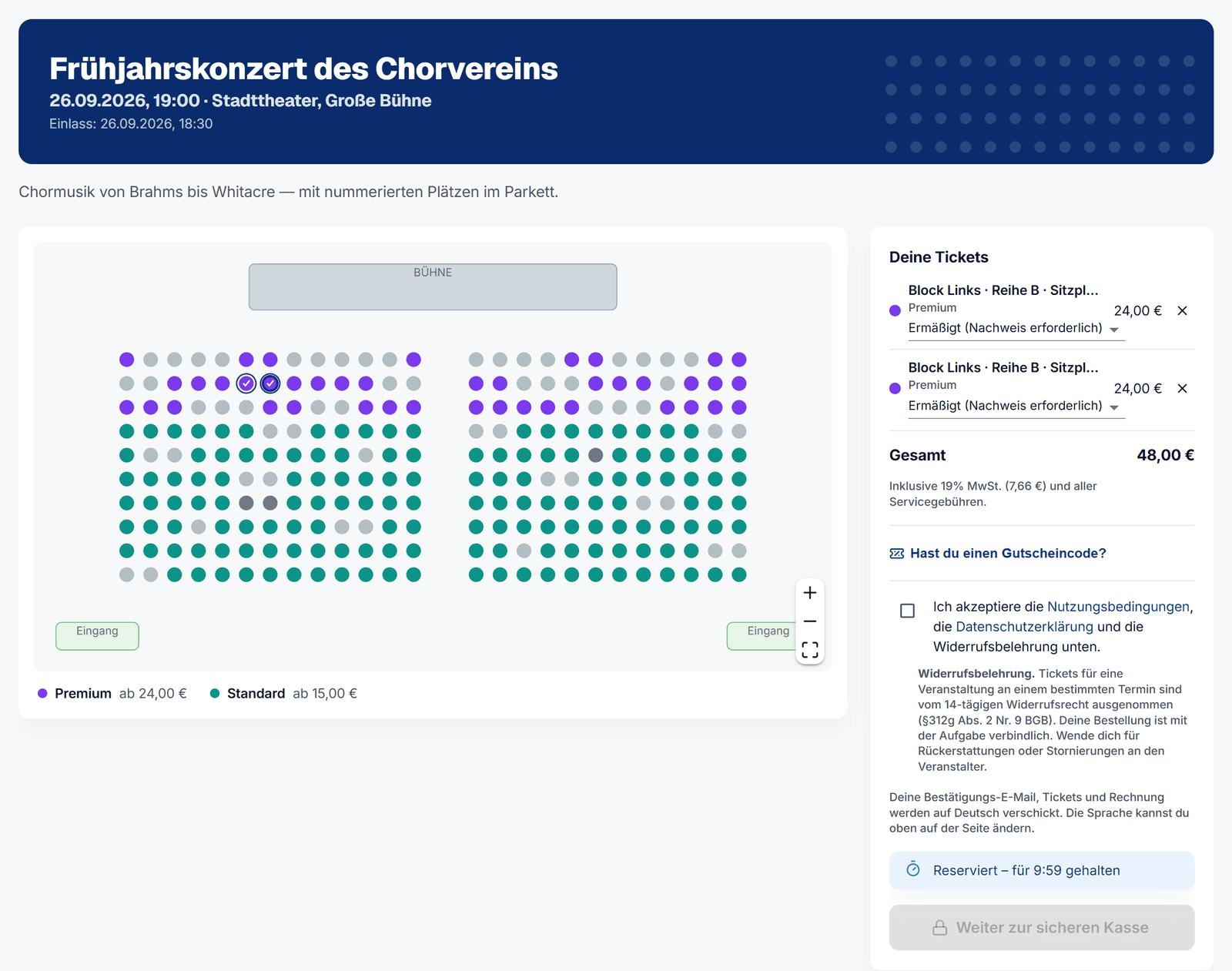
What to look out for in a seating plan:
- Free placement instead of rigid grids. You need to be able to move and remove individual seats and make rows different lengths. In cori you draw a single seat, a dragged row or a whole block of rows × seats — and fill irregular areas with seats automatically at the click of a button.
- Areas of any shape. Gallery, side aisle, transept: a rectangle is rarely enough. Rectangle, circle and freely drawn polygon cover a church too.
- Price categories with their own colours. So buyers immediately see that the side wing is cheaper. A seat's colour is its category — that makes mistakes in the plan visible at a glance.
- Being able to block and mark seats. For technical staff, guests of honour or the row behind the pillar. You should also be able to flag wheelchair spaces, companion seats and seats with a restricted view as such — that's independent of the price.
- Landmarks nobody buys. Stage, entrance, exit, bar, toilets and free text labels belong on the plan, but must never end up on sale.
- Levels for multi-storey halls. Stalls, balcony 1, balcony 2 as separate levels you can show and hide — otherwise the plan becomes unusable.
- Standing-room zones alongside numbered seats. An area that only has a capacity and no individual seats can be mixed with seated areas in the same plan.
- 2D or 3D for the buyer's view. For a flat parish hall, 2D is clearer. For a hall with balconies, a 3D view helps, because you immediately grasp what "balcony 2, row 9" means for the view. You decide what your guests see.
- Open seating as an option. Not every concert needs numbered seats. Advent carol singing in a packed church works without them, and the sale goes faster.
The first time you draw a hall plan, set aside a quiet hour and walk through the real room once with your phone. Count the rows, note where the pillars are, and photograph the view from the bad seats — that's the groundwork that makes the plan good.
A price category is not the same as a price
A detail that a surprising number of ticketing systems get wrong, and one you run into every week in practice.
Most systems only know one level: a "ticket type" has a name and a price. If you want to offer both a regular and a concession price in the stalls, you have to create two ticket types — and split the seats between them. Row 3, seat 5 then belongs either to "Stalls regular" or to "Stalls concession". A pupil who wants to sit next to their parents is out of luck.
The right approach separates two questions:
- Where do I sit? That's the category: stalls, gallery, standing room. It has the colour, the seats and the allocation.
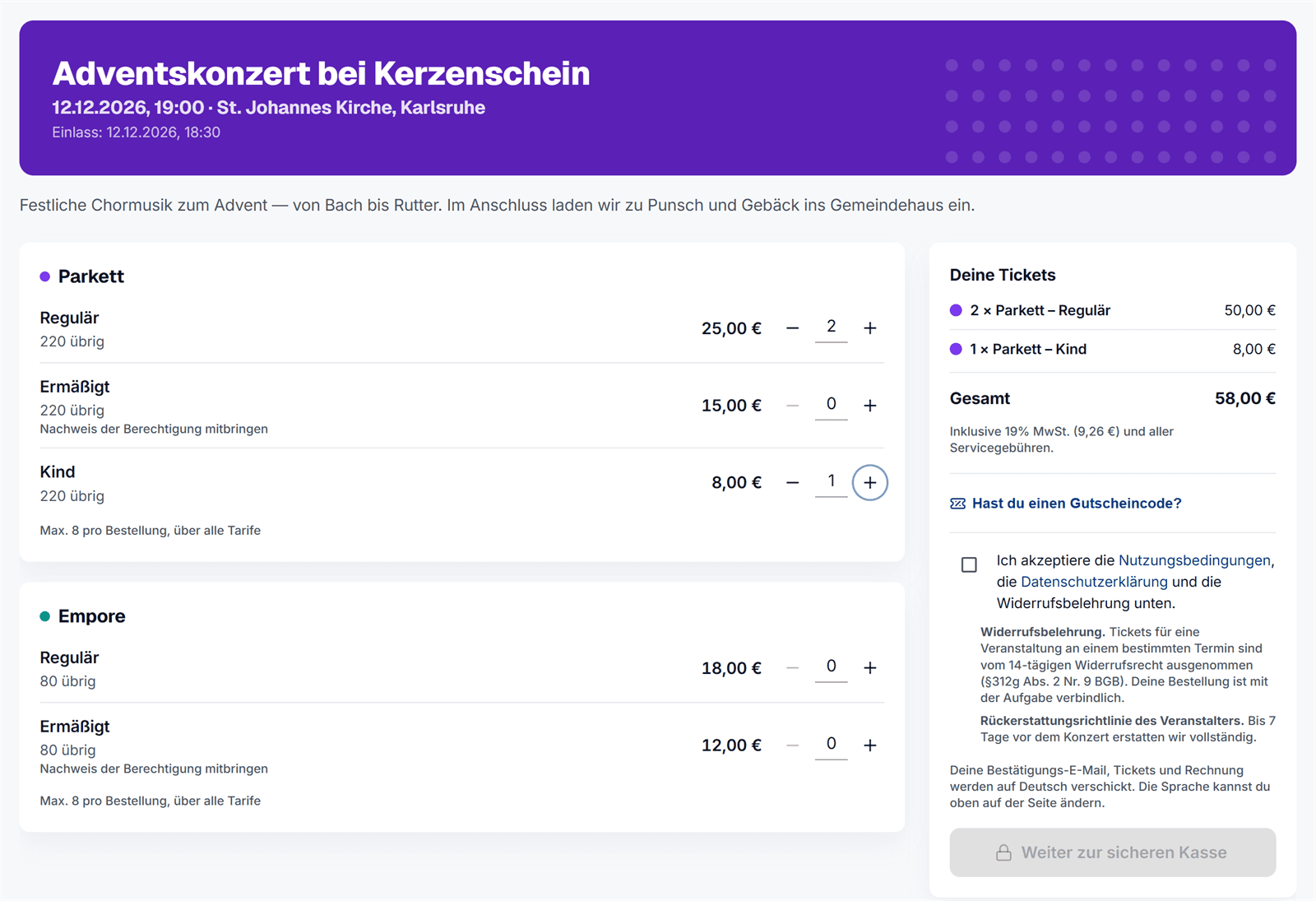
- What do I pay? That's the rate: regular €25, concession €15, child €8.
Every seat in every category can be booked at any rate belonging to that category. That's how cori Tickets works. In practice that means:
- A family sits together even though they book three different rates.
- You can cap a rate without capping the seats: "no more than 20 concession tickets" applies across the whole stalls.
- A rate can be marked as requiring proof. At the door, the scanner then shows that a student or disability card needs checking — that's the only point where this can be verified at all.
- Per category you can set a maximum quantity per order, so one person can't block the entire front row.
The price is fixed as soon as the seat is reserved — not only at payment. That sounds like a detail, but it prevents the classic error of two people buying the last concession ticket at the same time.
Guest checkout: selling tickets to an audience over 60
Nobody writes about this point, and it costs choirs more tickets than any fee.
A substantial part of your audience is made up of the parents, grandparents, neighbours and long-standing supporting members of your singers. Many of them will not create a customer account in order to buy a concert ticket. They won't do it because they don't want to, because they don't want to remember another password, or because they give up in the middle of the confirmation-email process.
Every step between "clicked the link" and "paid" costs you sales. So check specifically:
- Guest checkout without registration. Buyers enter name, email, payment details. Done. No account, no password to set.
- More than just credit card. A large part of your audience has no credit card or is reluctant to use one. SEPA direct debit, Klarna, Apple Pay and Google Pay noticeably reduce the drop-off rate; for concerts near a border or with guests from abroad, iDEAL, Bancontact, EPS, TWINT or MobilePay help as well. With cori you decide yourself what appears at checkout.
- The ticket arrives as a PDF by email and can be printed. A great many guests want something printed in their hand, and a printed QR code works at the door just as well as a phone screen.
- A way back to the ticket. The email lands in spam or gets deleted — that happens at every other concert. Guests should be able to have their tickets sent to them again without calling you. cori has "Find my tickets" for this: enter your email address, a link arrives, valid for 14 days. You can also resend an order with a single click.
- Collection at the box office as a payment alternative. Some guests are happy to pay online but still want a printed ticket. If your platform offers "pay online, collect at the counter", you get the planning certainty of advance sales and the feel of a paper ticket. You print the list of tickets to be collected beforehand.
- Someone buying for several people. A grandmother buys four tickets for the whole family. The shop has to deliver four tickets in one order and one email.
- The guest's language. The cori ticket shop is available in eleven languages, and the confirmation email, ticket PDF and invoice follow the language the buyer chose. For choirs with an international audience or concert tours, that's the difference between "understood" and "had to ask".
A good test: send the link to a choir member over 70 and ask them to buy a ticket without help. Whatever trips them up will trip up your audience too.
Admission on the night: scanning, even without a signal
The moment ticketing systems collapse in a village church isn't the sale. It's the admission.
Thick walls, no reception, no Wi-Fi, and 180 people standing outside in the drizzle. A scanner that has to ask the server about every code is useless there. What you need:
- The guest list sits on the phone. It's downloaded once before the concert and kept updated as long as there's a signal. If the network drops, checking carries on anyway. With cori the phone only stores one-way fingerprints of the codes, never the codes themselves — so a lost staff phone is no good for forging tickets.
- Every code exactly once. Showing the same ticket a second time is spotted immediately. Offline, that applies to all scans on the same device; as soon as two entrances are online again, they reconcile and report conflicts instead of silently swallowing them.
- Several entrances, without accounts. For the main entrance and the side door you each get a scanner link with its own name that expires at a set time. Whoever scans needs no cori account and installs no app from the store — the link opens the scanner in the browser, and anyone who wants can put it on their home screen as an icon.
- A paper backup. Export the admission list as CSV and print it. Even the best scanner is no help if the only staff phone falls into the water butt.
And one more point you only come to appreciate after your first concert: an order that has been refunded or charged back is automatically rejected at the door. With a paper list you'd never have noticed.
Free tickets, press and voucher codes
Two features every association asks about by their second concert at the latest.
Free tickets for press, sponsors and guests of honour. You issue them in the organiser area: enter the recipient, tap the seats on the seating plan, done. Nothing is charged and no invoice is created, but the tickets are real — each carries a code, is scanned at the door and takes up a seat from your allocation. If you want to hand the tickets over in person, simply switch off the email dispatch and print the PDFs. This is also the clean way to handle cash payments at the box office: take the money, issue a free ticket, and the seat is marked as taken in the system.
Voucher codes. As a percentage or a fixed amount, with an optional redemption limit and expiry date. Useful for "members recruit members", partnerships with the music school or an early-bird offer. Two things matter here: a code is only counted once the order has actually been paid — an abandoned purchase doesn't burn a redemption. And the organiser bears the discount: cori's fee is calculated on the undiscounted price and doesn't change. That's fairer than it sounds, because it lets you work out in advance what a promotion costs.
GEMA: what you have to register for your choir concert
Even as a non-profit choir you have to report your concert to GEMA as soon as you perform protected works. That applies regardless of whether you charge admission.
What you should know:
- Choir concerts fall under different tariffs depending on the programme — put simply, there's a tariff for popular music and one for predominantly classical music. Which one applies to you and what it costs is answered by the GEMA tariff calculator. Don't guess here, and don't take a percentage from a blog article — not even from this one.
- Members of a recognised choral federation get a 20% framework-agreement discount. The Deutscher Chorverband negotiated this for its members. If you're a member, state it when you register.
- You have to submit a programme report, meaning the list of works performed with composer and lyricist. Anyone who delivers it late pays a surcharge. It's best to collect it during the rehearsal phase.
- Music is GEMA-free if all its rights holders have been dead for more than 70 years. For a choir with classical repertoire that's more relevant than you'd think: Bach, Mozart, Mendelssohn and Brahms are in the public domain. Careful, though — this applies to every contributor: a modern arrangement or a new text makes an old work reportable again.
- GEMA calculates on the basis of your net income. Advance-sale and system fees are not part of the assessment base. So a ticketing provider with low fees doesn't reduce your GEMA costs — but a provider that itemises the fees cleanly saves you the argument about it.
You'll find the current tariffs and deadlines directly at GEMA for choirs.
VAT and non-profit activity: what belongs on the invoice
Here we leave the territory where a blog article can give binding advice. Take the following as a map, not as tax advice — and go through the details with your tax adviser or your tax office.
The basic line: admission fees for a non-profit association's own concerts normally fall under non-profit activity (Zweckbetrieb), because the concert directly serves the purpose set out in the statutes. For non-profit activity, the reduced VAT rate applies instead of the standard rate. Under certain conditions, cultural events can even be entirely exempt from tax.
Three points where associations regularly miscalculate:
- The sparkling wine at the interval is something different from the ticket. Sales of drinks, cake and merchandise are a commercial business operation and are treated at the standard tax rate. Two kinds of income, two tax rates, one evening.
- An admission fee is not a donation. Anyone who receives something in return — namely the concert — is not donating. A donation receipt may not be issued for it. If you want to collect donations, make that a separate, voluntary item.
- The small-business rule may apply if your association stays below the statutory turnover thresholds. The thresholds were raised recently — check the current status instead of relying on older guides.
In practice that means your ticket shop should be able to issue invoices with sequential numbering, made out in your association's name, with a selectable tax rate. That's exactly the feature most large ticketing platforms sidestep: they issue the invoice in their own name.
With cori Tickets the association is the seller, and the invoice is created accordingly:
- Per event you choose the standard rate of 19%, the reduced rate of 7% or exempt (non-profit) — or enter your own rate.
- Invoice numbers run without gaps per seller, not per event. A number sequence that starts back at 1 for every concert is exactly the mistake that Section 14 of the German VAT Act (UStG) doesn't forgive.
- Every invoice is a frozen snapshot: if you later change the association name or the ticket price, an invoice already issued stays unchanged.
- For the bookkeeping you can download all invoices for an event as one combined PDF, plus the order and ticket lists as CSV.
Returns and withdrawal: why you need terms and conditions
A question that reaches every choir sooner or later: "I've fallen ill, do I get my money back?"
The legal answer surprises many people: there is no statutory right of withdrawal for event tickets. Section 312g(2) no. 9 of the German Civil Code (BGB) expressly excludes leisure events tied to a specific date from the distance-selling right of withdrawal. The Federal Court of Justice has confirmed that this also applies to purchases made through an intermediary (summary by IT-Recht Kanzlei). The 14-day rule your audience knows from online shopping does not apply here.
Three things follow from this:
- Every refund is voluntary and depends on what you yourself have promised. That's why you need terms and conditions stating whether and until when you take tickets back. Write in a sentence you're also willing to keep to. A generous "we refund in full up to 7 days before the concert" builds trust and is easy to handle. In cori you store these cancellation terms once; they then appear on the event page and directly above the payment button.
- The buyer must see who they're buying from before paying. The organiser's name and address belong visibly on the page, as does the withdrawal notice with the note that the 14-day right of withdrawal doesn't apply here. Make sure your platform supports this — and that the buyer's consent is documented.
- If the concert is cancelled, guests get their money back. That's not goodwill, it's the consequence of you not delivering what you promised. Make sure your platform makes refunds easy — with cori you trigger them per order directly in the organiser area, and the money goes back to the guest out of your own balance.
A practical tip from the association world: instead of a refund, first offer an exchange for the next concert. Many guests are happy to take it, and the money stays with the association.
cori Tickets: ticket sales that sit next to your rehearsals
If your choir already uses cori, your concerts are already in the same calendar you use for rehearsals. cori Tickets turns one of those appointments into a ready-made ticket shop. No second system, no new sign-up — you log in with the cori account you already have.
- Turn an appointment into an event. Take the concert from the cori calendar or create a new one, define categories and rates — and for a seated hall, draw a seating plan in 2D or 3D.
- Share the ticket shop. One link to singers, families and fans. Buyers choose their seat and pay in seconds, without an account. If you like, your event also appears in the public overview at tickets.cori.music.
- Get paid out automatically. The income goes to your association's account daily — already during the advance sale. No detour via cori, no waiting for a lump transfer after the concert. Tickets and invoice go out automatically by email.
- Scan on the night. The scanner runs in the browser, works without a signal and lets every code through exactly once. You export the admission list, seat manifest and box-office list as CSV.
What else is included, at no extra charge:
- Ticket designer: upload your own PDF or image as the background and place the code and fields freely — QR code, Code 128 or EAN-13. Or take the standard layout and be done in a minute.
- Sales period: announce the concert today, start the advance sale on a fixed date and have it close automatically.
- Team & access: several board members manage the same event.
- Names per ticket, if you need them — for galas and members-only events. For normal concerts it stays off.
- Banner image, admission time, description and time zone for an event page that doesn't look like a form.
- Seller details, terms-and-conditions link and cancellation terms in the places the law requires them.
The terms: 5% + €0.50 per ticket sold, payment fee included. No subscription, no setup costs, no minimum term. Free tickets cost you nothing either. And you decide per category whether you bear the fee or add it to the price.
That puts us well below the big platforms from the example calculations above — and you know the number in advance, regardless of how your audience pays. The difference lies elsewhere: your money is in your own account from the first ticket, the invoice is issued in your association's name, and the seating plan is designed for a parish hall, not an arena.
Timeline: from the decision to the night of the concert
| When | What |
|---|---|
| 10–12 weeks before | Choose a provider, create an account, add your bank details |
| 8–10 weeks before | Draw the seating plan, define categories and rates, enter seller details and tax rate |
| 8 weeks before | Publish the shop and share the link — even if the programme isn't final yet |
| 6 weeks before | Submit the GEMA registration, collect the programme report |
| 4 weeks before | First reminder to choir members, show the running total at rehearsal |
| 2 weeks before | Issue free tickets for press and sponsors, hold back the box-office allocation |
| 2 days before | Create the scanner links, open and sync the scanner once on every admission phone |
| On concert day | Print the admission list as CSV, put cash ready for the box office |
| After the concert | Report the programme to GEMA, export the invoices as a combined PDF, do the accounts |
Tips for selling more tickets
- Open the shop as soon as the date is set. Even if the programme isn't final yet. A concert that's bookable for six weeks sells more than one that's bookable for two.
- Turn your singers into ambassadors. If 40 members each send the link to five people, you've reached 200 contacts — without a cent of advertising.
- Offer three price tiers, not seven. Adults, concession, children. More choice doesn't bring extra sales, only extra questions.
- Numbered seats for special concerts. Someone who gets to pick a good seat buys earlier and values the ticket more.
- Show the running total at rehearsal. "30 seats left" is the most effective prompt you can give your own choir.
- A picture beats a description. A photo from the last concert on the event page and in the shared link measurably increases the click rate.
- Use the channels you already have. The parish newsletter, the church website, the noticeboard at the music school and the local paper reach exactly the audience that turns up in the evening.
Frequently asked questions
What does selling tickets for a choir concert cost? On a €15 ticket, most providers land between roughly €1 and €1.55 per ticket sold including the payment fee, depending on the payment method; individual platforms charge almost €3. cori Tickets costs a fixed €1.25 — 5% + €0.50, payment fee included. Two things are decisive in the comparison: the fixed fee per ticket, which dominates the sum on cheap tickets, and whether the payment fee is included or comes on top separately.
Is there a ticket shop without a monthly base fee? Yes. cori Tickets and most of the big platforms too work without a subscription and charge per ticket sold — for a choir with two to four concerts a year, almost always the right model. Pay less attention to the base fee and more to whether the payment fee is included in the ticket price: that's where the costs sit that appear on no pricing page.
When does the money from ticket sales reach the choir? This differs fundamentally. With many platforms — EVENTIM.Light and Eventbrite, for instance — only after the event. With cori Tickets on an ongoing basis, with a daily payout to your association's account, so already during the advance sale. Ask every provider about this explicitly.
Do ticket buyers need a customer account? With good providers, no. Look out for "guest checkout" or "checkout without registration". With an older audience in particular, forced registration is the most common reason for an abandoned purchase.
How do I sell numbered seats for a concert in a church? You map the room once as a seating plan — rows, blocks, gallery, stage — and assign each seat a price category. Buyers then choose their seat directly on the plan. What matters is irregular rows, freely drawable areas, wheelchair spaces and the ability to block seats behind pillars.
Can one seat be sold at several prices? With cori, yes: the seat category ("stalls") and the rate ("regular", "concession", "child") are separate, so every seat is bookable at every rate. In systems where the ticket type is also the price, you have to split the seats — and then a pupil can't sit next to their parents.
How do I check tickets at the door when there's no signal? With a scanner that loads the guest list onto the phone in advance. Open it once while there's reception; after that it keeps checking codes offline and uploads the check-ins as soon as there's a connection again. Print the admission list as CSV as well — as a backup.
Does a choir concert have to be registered with GEMA? Yes, as soon as protected works are performed, regardless of admission fees and non-profit status. The exception: if all the rights holders of the works performed have been dead for over 70 years, the programme is in the public domain. You determine the tariff via the GEMA tariff calculator.
Which VAT rate applies to a non-profit association's admission fees? A choir's own concerts normally fall under non-profit activity and therefore the reduced tax rate; sometimes a full tax exemption applies. Sales of drinks and merchandise, by contrast, belong to the commercial business operation. Clarify the classification with your tax adviser.
Can visitors return concert tickets or withdraw from the purchase? There is no statutory right of withdrawal for leisure events tied to a date (Section 312g(2) no. 9 BGB). Returns are voluntary and depend on your terms and conditions. If the concert is cancelled, you have to refund.
How do I issue free tickets for press and sponsors? Through the organiser area. The tickets are full tickets with their own code and take up a seat, but trigger no payment, no fee and no invoice. If you want to hand them over in person, switch off the email dispatch and print the PDFs.
Is a ticket shop worth it for a small choir? From around 100 tickets sold per concert, almost always. Below that, it's less the fee that decides than the question of how much time your volunteers spend on lists and cash.
Does this also work for orchestras, music associations or carnival clubs? Yes. cori Tickets grew out of the choral world, but a seating plan, a guest checkout and a proper invoice are the same task for a wind orchestra, a sports club or a carnival gala. You don't have to be a choir for that.
The bottom line
Ticket sales shouldn't be the stressful part of your concert. Choosing a provider takes an evening, setting up the shop an hour, and after that it runs by itself.
When choosing, ask the four questions nobody else asks: when is our money in our account? Is the payment fee included in the price? Whose name is on the invoice? And will my 78-year-old aunt get through the purchase without help? The answers to those matter more than any tenth of a percentage point in a fee comparison.
Want to see what this looks like for you? Take a look at cori Tickets and set up your ticket shop in a few minutes. Data in Frankfurt, payout to your association's account, German-language support from Karlsruhe. If you need help with your first seating plan, just write to us — we're happy to draw it together with you.
And if you're in the middle of sorting out your whole choir life: how to bring rehearsals, sheet music and practice recordings together in one place is covered in the comparison of choir apps 2026 and in the guide to choosing a choir app.
This article is no substitute for legal or tax advice. Details on fees, tariffs and tax rates are current as of July 2026 and may change.Get your choir ready for the future
So you can concentrate on what matters most: the music.
Share this article
More Articles

The 6K practice room for the 2027 season: now in the browser too
6K UNITED! has opened the 2027 season, and cori's 6K practice room is ready: every song with chapter markers, follow-along lyrics and sheet music, groups and appointments for teachers, and for the first time in the browser as well, with nothing to install. What's new and how you get started.

Ear Training Without Sheet Music: the New Learning Path in cori
Train your ear, your rhythm and your voice – step by step, without reading music, in two-minute sessions. The new Learning Path in cori: in the app and the browser.