Voice type test: which part do you sing in a choir?
Sing your lowest and your highest note. Two minutes later you know whether soprano, alto, tenor or bass suits you.
- Measures your range to the semitone
- Nothing is recorded, everything stays in your browser
- No microphone? Sing along to notes instead
Find your voice type
Sing a relaxed "ah" and glide down to your lowest note.
Then go up, as high as you can without pushing.
Hold each note briefly until it locks in. Then you'll see which voice suits you.
Pitch detection runs only in your browser. Nothing is recorded or uploaded.
Found your voice? Time to practice.
With cori you practice your part at home, with the pieces your choir is rehearsing right now.
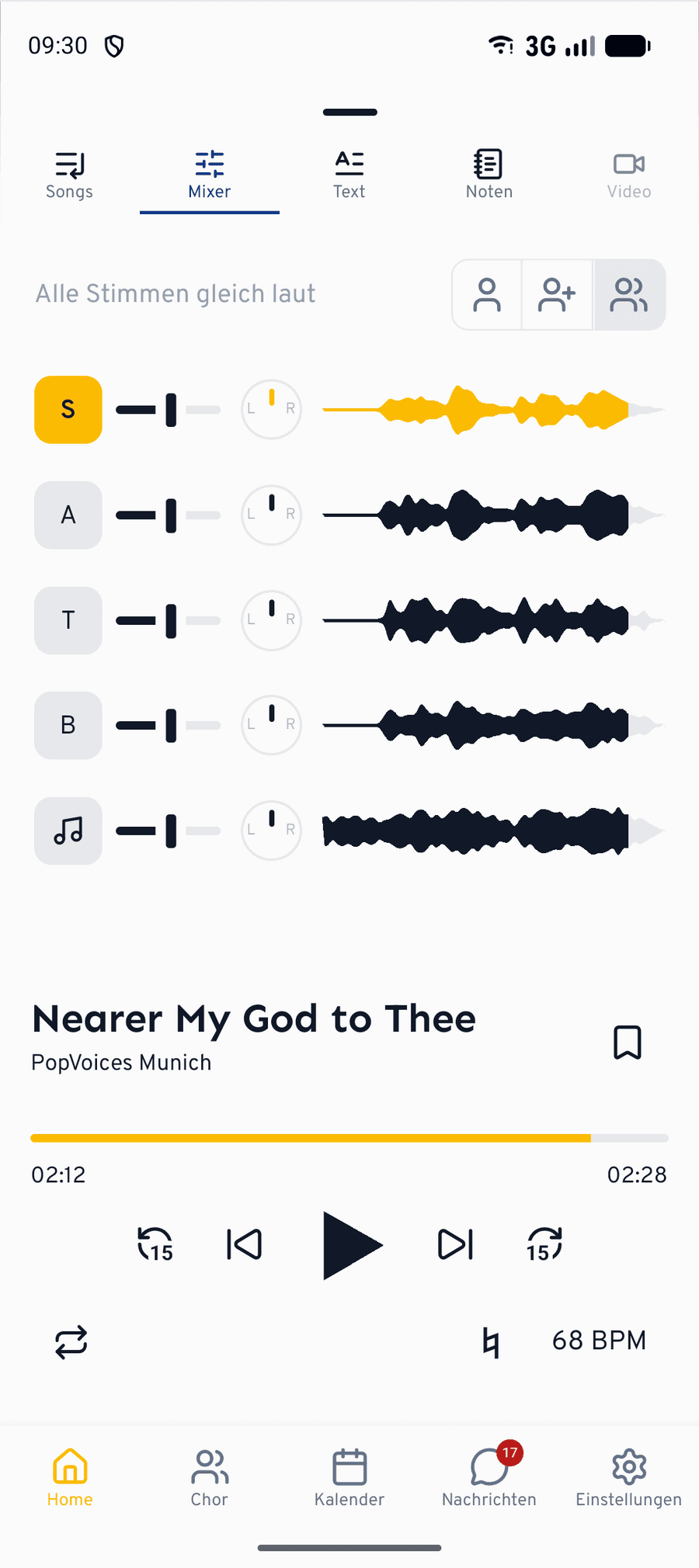
Every part on its own track, mixed as loud as helps you
When you sing along, cori shows whether pitch and rhythm are right
Voice training that stays within your range
Sheet music, events and choir chat in one app
The voice types in a choir
Soprano, alto, tenor and bass are the four choir parts, with mezzo-soprano and baritone in between. Tap a voice to hear its range.
Soprano
C4 to C6 · In a choir: Soprano
The highest voice in the choir. Sopranos usually sing the melody and shine above the other parts.
Mezzo-soprano
A3 to A5 · In a choir: Soprano 2 or Alto 1
Sits between soprano and alto and can strengthen either part in a choir.
Alto
F3 to F5 · In a choir: Alto
The lower of the high voices. Altos sing below the melody and give the choir its warmth.
Tenor
C3 to C5 · In a choir: Tenor
The higher of the low voices. Tenors shine up high and often carry the melody.
Baritone
A2 to A4 · In a choir: Bass 1 or Tenor 2
Sits between tenor and bass. Usually at home in the basses, often welcome in the tenors too.
Bass
E2 to E4 · In a choir: Bass
The lowest voice in the choir. Basses lay the foundation that all the other parts stand on.
How to get an accurate result
Warm up first
Hum or do lip trills for two minutes. A cold voice makes your top sound narrower than it is.
Don't force it
Count only what you'd also sing in a choir. Growling low notes and squeaky high ones don't count.
A quiet room
Music or voices in the room confuse the pitch detection. Keep your device about an arm's length away.
Test twice
Your voice often sits lower in the morning than in the evening. Test on two days and compare.
Practical Answers
Sing your lowest and your highest comfortable note, just like in the test above. Your lowest note says the most: it depends mainly on your voice, while your top grows with practice. Whether a voice suits you in the long run is something you'll notice when you sing in a choir.
A mixed choir usually sings in four parts: soprano and alto are the high voices, tenor and bass the low ones. Mezzo-soprano and baritone sit in between. When a part splits, it becomes, for example, Soprano 1 (higher) and Soprano 2 (lower).
The test measures the notes you hold to the semitone. Your voice type is an estimate based on your range. No test can hear your timbre or where your voice sounds best. Take the result as a starting point for a chat with your choir director.
No. Pitch detection runs entirely in your browser. Nothing is recorded, stored or sent to a server.
Yes. Women sing tenor in many choirs, and some men with high voices sing alto. What matters is your range, not your gender. If the test says tenor, talk to your choir director.
Yes. Children's voices change as they grow, most of all when the voice breaks. Practice extends your range, mostly upwards. Over the years, voices often get a little lower.
Your vocal range runs from your lowest to your highest note. Your voice type places that range in a part, such as alto or tenor. So two people with ranges of the same size can have different voice types.
Please do. Send new members the link before their first rehearsal, so they already know their range. Children can take the test too: nothing is recorded, and the result shows where their voice is comfortable right now.
Your whole choir in one app
Practice tracks for every part, sheet music, events and chat in one place. Choir directors can try cori free for 30 days.
Get started