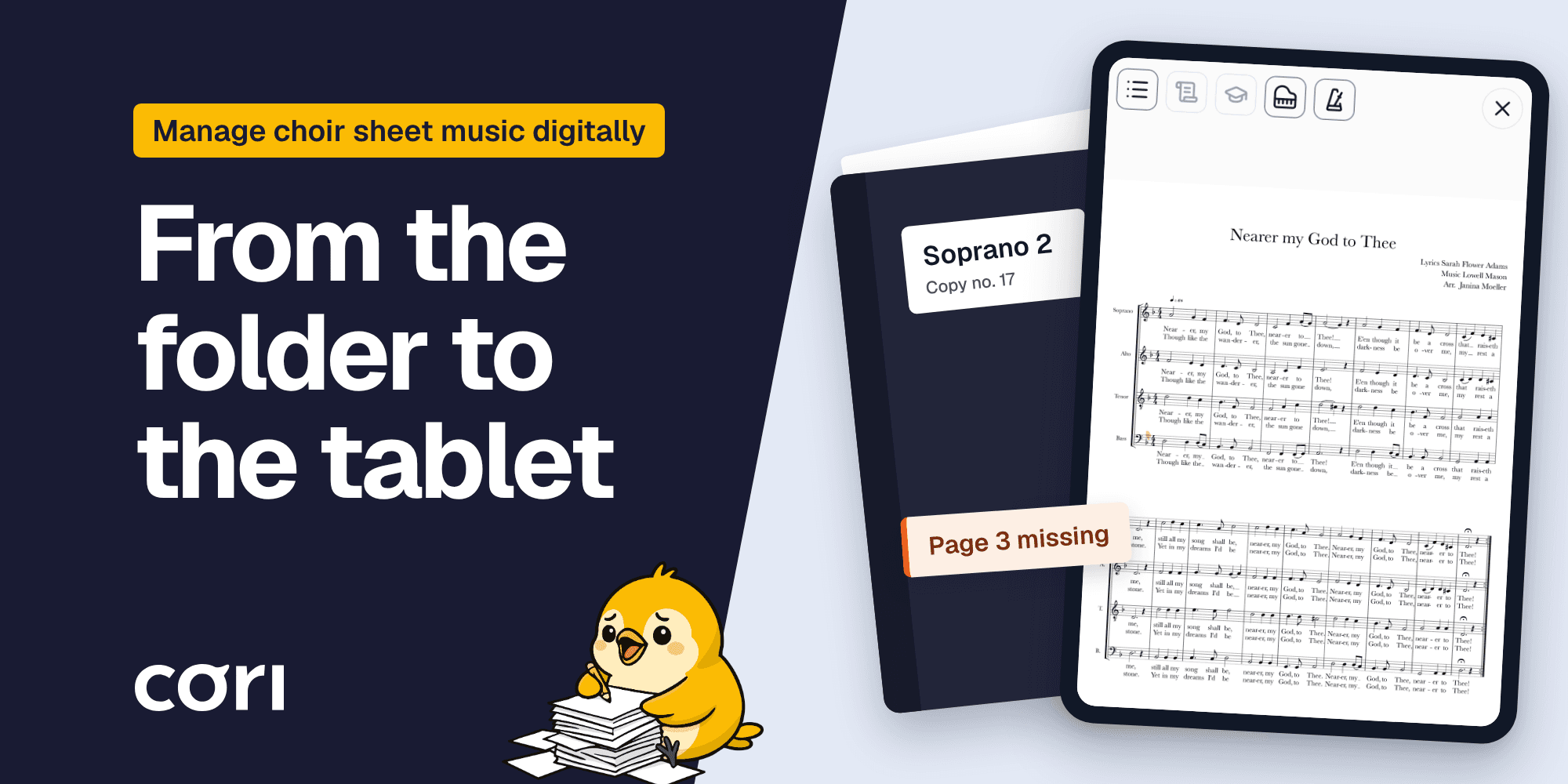
Manage choir sheet music digitally: from folder to tablet
Updated November 4, 2026
•

Jonas Deuchler
Founder, coriIn many choirs, a page goes missing somewhere on rehearsal night: one folder is still at home, another is missing page 3 of the new piece, and the music librarian is checking her spreadsheet to see who has copy 17. Then the conductor announces a cut from bars 34 to 41, and forty people write it into forty folders, one by one.
To manage choir sheet music digitally is to get rid of exactly this friction. The short answer: each piece exists once as a clean PDF, in one place everyone can reach. Singers read from a tablet, even without signal, and the conductor's markings reach everyone. You may only share what you have enough copies or a digital licence for, and sometimes paper is still the better choice.
At cori I'm responsible for product and app development, and I help build the sheet music features. When choirs want to move to tablets, there's usually a question that comes before choosing an app: are we even allowed to scan our music? cori gets its own section at the end; everything before it applies whatever tool you use.
Where the choir folder reaches its limits
The choir folder is robust, needs no battery and works in every church. It struggles with anything that changes:
- Changes: every cut and every new version has to go into each folder separately.
- Completeness: whoever misses a rehearsal misses the new pages.
- Inventory: who has which copy is often known only to the person with the spreadsheet.
- Photocopying: missing pages are quickly copied, and with sheet music that is legally tricky.
Manage choir sheet music digitally: what you need
Going digital doesn't mean sending every PDF to a group chat. Why that doesn't hold up over time is covered in Organize a choir without WhatsApp. What lasts has three parts: a clean library with one entry per piece, one place with clear access rights where a new version reaches everyone at once, and one device per person, usually a tablet, with the music stored locally.
Which choir sheet music app fits?
| Option | Suits | Limits |
|---|---|---|
| Paper choir folder | project choirs with one concert, choirs with few tablets | changes, missing pages, photocopying |
| Shared cloud folder with PDFs | a small budget, everyone comfortable with files | no shared markings; offline only what each person saves |
| Reader for individuals, e.g. forScore or MobileSheets | you, if you sing from a tablet whatever the choir uses | everyone buys and maintains their own library, no shared markings in the choir |
| Choir app with sheet music, e.g. cori or Choirmate | choirs that want music, the conductor's markings and practice tracks in one place | usually an ongoing cost; offline use, markings and plans vary a lot |
What to digitise, and how
Start with the pieces for the next three months, not the whole archive. Scanning protected editions needs permission anyway (more on that below).
Scanning: one piece, one song
An office scanner will do, and so will your phone camera. In cori you photograph the pages right in the app while creating a song, and you end up with one PDF with all pages in the right order (help: creating a song). cori also recognises the scanned music, plays each voice back to you and produces a MusicXML file; you check the result and then release the song to the choir (how the sheet music recognition works). Whatever you scan with: check on the tablet that accidentals, ties and lyric syllables are legible and nothing is cut off.
Choral score and conductor's version
Usually everyone sings from the same choral score while the conductor works from a vocal score or their own marked-up copy. Keep the two apart: in cori, each song has one sheet for everyone and, if you like, a second one that only the choir leadership and admins can see. If a piece exists for upper voices and for mixed choir, those are two pieces, not two versions of one file.
Copyright: what you may copy and share digitally
Copying sheet music needs permission, even in an amateur choir. Under § 53(4) of the German Copyright Act, sheet music may only be copied, other than by writing it out by hand, with the rights holder's consent. VG Musikedition, the collecting society that manages copying rights for many music publishers, stresses that this applies to analogue and digital copies alike. In its words, the law provides no “relevant exceptions in practice, e.g. for amateur music-making, […] for non-commercial or private purposes” (VG Musikedition, our translation).
A scan is a copy, even if you only scan a book you bought for your own tablet. According to VG Musikedition, the legal exceptions hardly matter in practice (legal situation under § 53(4)): the exception for your own archive, for instance, only covers copies on paper or purely analogue use, and such copies may not be passed on (§ 53(2) and (6)).
The way forward is the publisher. Some publishers sell choral music as PDFs. At Carus-Verlag, for example, digital use depends on the number of copies bought, and each person uses the file either on a device or as a printout (Carus FAQ). If you want to scan books you bought, ask the publisher first and keep the reply.
Church choirs: the blanket licence between the Evangelical Church in Germany (EKD) and VG Musikedition, extended to the end of 2032, covers copies for congregational singing. Copies for choirs, soloists and instrumentalists are explicitly excluded (press release, June 2025). The agreement with the Catholic dioceses also applies to congregational singing (VG Musikedition).
Choir associations and grants: the Deutscher Chorverband's agreement with the performing rights society GEMA brings discounts for concerts and other music use, but says nothing about copying sheet music (DCV). Some associations and municipalities do help with buying, though: the Chorverband Berlin covers up to €300 of sheet music purchases within its concert funding (funding guidelines, January 2026), and its member choirs can use the association's library of choral scores, with enough copies for a whole choir, free of charge (CVB). The Hannover region's choir funding also covers purchases such as sheet music worth up to €1,000, paying at most 75 % of the cost (choir funding, guidelines 2027 to 2029). Ask your regional association and your municipality before you buy a set of books for the whole choir.
A work is only in the public domain once everyone involved has been dead for 70 years, counted from the end of the year of death (§ 64, § 69). That includes lyricists (§ 65(3)) and arrangers, because an arrangement is a work in its own right (§ 3). And an Urtext or complete edition can be protected as a scholarly edition for 25 years after publication, even if the piece itself is free (§ 70, VG Musikedition).
Careful with IMSLP: the library accepts works on its main servers in Canada if the last contributor died in 1971 or earlier (IMSLP). If the last person involved died between 1956 and 1971, the work is still protected in Germany in 2026.
In practice: note the licence status of every piece and keep the records. An app only distributes what you are allowed to distribute. The tool doesn't change the legal position.
Choir sheet music offline: rehearsing in a church without signal
Thick walls and basements swallow reception. Digital sheet music only works there if it is stored on the device beforehand; a cloud folder in the browser won't do. The routine:
- The day before, open the app on Wi-Fi and download the pieces.
- Open each file once so it really is stored locally.
- Switch to flight mode and check that everything is there.
A dress rehearsal, a warm-up and two concerts are a lot for an older tablet. Charge it fully the night before, bring a power bank and turn the brightness down. With no socket within reach, paper is the more relaxed choice on a day like that.
Notes and the conductor's markings
Pencil marks are part of every rehearsal, and digitally they should work at least as well:
- Who sees what: breath marks and your own tricky spots stay private. The conductor's cuts, dynamics and entries should reach everyone without forty people copying them down.
- Stylus or finger: with a stylus it feels almost like a pencil; with a finger, ticks and circles are enough.
- Markings on paper: whoever sings from the printed copy needs the markings too, for example via a PDF export with the annotations shown.
Tablet, phone or paper?
A tablet doesn't replace the folder everywhere.
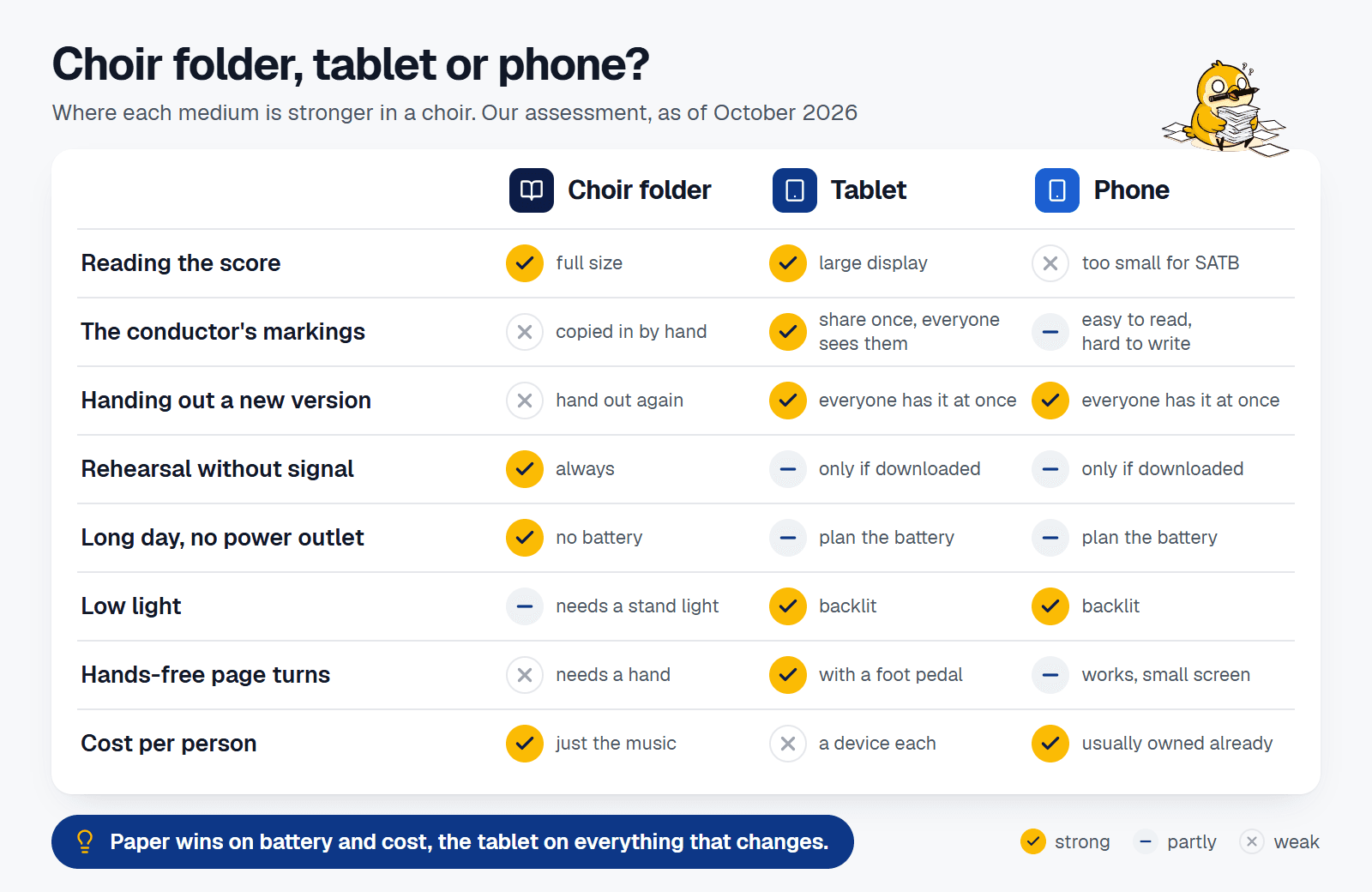
- Tablet: the best digital option for four-part scores. The bigger the screen, the closer to paper size. The downsides are cost, battery and glare in sunshine. For stands and mounts, see our comparison of tablet holders.
- Phone: fine for lyrics, single-line melodies and as a backup, but too small for an SATB score.
- Paper wins for a project choir with a single concert, when many members have no tablet or don't want one, on long days without a socket and outdoors in bright sun.
Mixed use is normal: whoever has no tablet sings from the printed copy. What matters is that the conductor's markings reach them too.
Page turns: foot pedal, half pages, jump marks
For long works and for the conductor, page turns are worth planning:
- Tapping or swiping is enough for most pieces if you know where there's a rest to turn.
- Bluetooth foot pedal: one press turns forward or back and your hands stay free. The common sheet music apps support such pedals, and so does cori.
- Scrolling instead of turning: if you'd rather not turn pages at all, let the music run as one continuous strip. In cori you switch between the two in rehearsal mode.
- Jump marks: a jump mark takes you from a repeat to its target page with one tap.
- Half-page turns: in portrait, you still see the bottom half of the current page while the top half of the next one is already showing, so you turn during a rest instead of mid-phrase. So far only a few readers for individuals offer this.
Managing choir sheet music with cori
This is how we do it in cori, along with the limits you should know about.
Sheet music belongs to the song. Each song has one sheet for all members and, if you like, a separate conductor sheet that only the choir leadership and admins can see (help: the sheet music viewer). Alongside it are the lyrics and practice tracks for each voice, which your singers turn up or down in the mixer (more in getting the most out of practice recordings). In the app you can scan sheet music with the camera while creating a song, and cori recognises the music as you do and plays each voice back to you. Only the choir leadership and admins can create songs and upload files, which helps with licensing (help: roles and permissions).
In rehearsal: the app's rehearsal mode leads you through the setlist, and a Bluetooth pedal turns pages if it sends arrow, page or space keys. “Dark sheet music” inverts the colours for low light, “Scroll vertically” switches from page turns to one continuous strip, “Advance automatically” jumps to the next title after the last page, and jump marks bridge repeats (help: the sheet music viewer, annotating sheet music).
Annotations: in the app you write on the music with a stylus or your finger and choose for each mark: private, your section or the whole choir. Only the choir leadership and admins can share with the whole choir; members can share with their section if the choir settings allow it (help: sharing annotations). Anyone online usually sees a shared marking shortly afterwards, even in music that is already open. When you export a PDF in the app, the annotations currently shown can come along (help: exporting sheet music).
Offline: the app stores downloaded songs and their sheet music locally. Open it once with a connection before rehearsal, download the songs (or turn on “Download songs automatically” under Settings › Network) and open the sheet music once (help: using cori without internet).
What cori can't do:
- There are no half-page turns.
- There are no separate PDFs per voice, only the member sheet and the conductor sheet. Put individual parts in Files, visible to admins only if you prefer (help: uploading files, visibility of files).
You can try cori with your whole choir for 30 days, without payment details, and the trial doesn't turn into a paid subscription automatically (help: the trial). If you'd like to try it with your own repertoire:



Frequently asked questions
May we scan the choral scores we bought for our tablets? Only with permission. In Germany, § 53(4) of the Copyright Act makes copying sheet music subject to the rights holder's consent, on paper or digitally, and amateur choirs are no exception. Ask the publisher or buy PDF licences for as many people as you need.
Is there a blanket licence for choirs to copy sheet music? Not in Germany, as far as we could find. The churches' blanket licences cover congregational singing, and the Protestant one explicitly excludes copies for choirs. Some choir associations and municipalities do subsidise buying sheet music, though (as of October 2026).
Does digital sheet music work in a church without signal? Yes, if it is stored on the device beforehand. A cloud folder in the browser is not enough. In cori, the app takes care of this: open it once with a connection and the songs are stored on the device.
Is a smartphone enough for choir sheet music? For lyrics, single-line melodies and as a backup, yes. For a four-part score a phone screen is too small, so you keep zooming and scrolling. If you sing from a screen regularly, a tablet is the better choice.
How do you turn pages digitally without using your hands? With a Bluetooth foot pedal that connects to the tablet like a keyboard. cori supports such pedals in the app. If you would rather not turn pages at all, switch to continuous scrolling there.
Can we take our sheet music with us if we leave cori? Yes. In the choir settings, the choir leadership and admins can download a ZIP file at any time under “Export data”: songs with their voices, sheet music and lyrics, Files, appointments, setlists and the member list.
Conclusion
Digital sheet music pays off for choirs that rehearse new repertoire regularly and whose conductor doesn't want to announce every marking forty times. The switch rarely fails because of the app. It fails on two questions that should be settled first: which licences do we have, and how do we bring along everyone who stays with paper? Start with one programme, not the whole cupboard.
Sources
- § 53 UrhG: Vervielfältigungen zum privaten und sonstigen eigenen Gebrauch. Bundesministerium der Justiz und für Verbraucherschutz.
- Vervielfältigungen. VG Musikedition.
- Rechtslage gemäß § 53 Abs. 4 UrhG. VG Musikedition.
- FAQ & Hilfe. Carus-Verlag, question “Darf ich die Ausdrucke kopieren bzw. Dateien weitergeben?”.
- VG Musikedition und EKD verlängern Pauschalvertrag. VG Musikedition and Evangelische Kirche in Deutschland, 2025, joint press release.
- Katholische Gemeinden. VG Musikedition.
- GEMA-Gesamtvertrag des DCV. Deutscher Chorverband.
- Informationen und Förderrichtlinien zur Konzertförderung des Chorverbands Berlin. Chorverband Berlin, 2026, section Sachausgaben: Noten.
- Top 10 der guten Gründe, um Mitglied im Chorverband Berlin (CVB) zu sein. Chorverband Berlin.
- Chorförderung. Region Hannover, 2026.
- Richtlinie der Region Hannover für die Gewährung von Zuwendungen für die Chorförderung (2027-2029). Region Hannover, sections 3.2 and 7.2.
- § 64 UrhG: Allgemeines. Bundesministerium der Justiz und für Verbraucherschutz.
- § 69 UrhG: Berechnung der Fristen. Bundesministerium der Justiz und für Verbraucherschutz.
- § 65 UrhG: Miturheber, Filmwerke, Musikkomposition mit Text. Bundesministerium der Justiz und für Verbraucherschutz.
- § 3 UrhG: Bearbeitungen. Bundesministerium der Justiz und für Verbraucherschutz.
- § 70 UrhG: Wissenschaftliche Ausgaben. Bundesministerium der Justiz und für Verbraucherschutz.
- Rechtslage gemäß §§ 70, 71 UrhG. VG Musikedition.
- Public domain. IMSLP.
All links accessed on 4 November 2026. This article is not legal advice. Information on laws, agreements, prices and features: as of October 2026.
Get your choir ready for the future
So you can concentrate on what matters most: the music.
Share this article
More Articles

Practice recordings in the choir: How your singers really practice at home
Practice recordings are the most valuable tool between rehearsals, if you use them right. From MIDI and scanned sheet music to sung-in parts, from listening to a practice plan for the next rehearsal: how practice material turns into real practice.
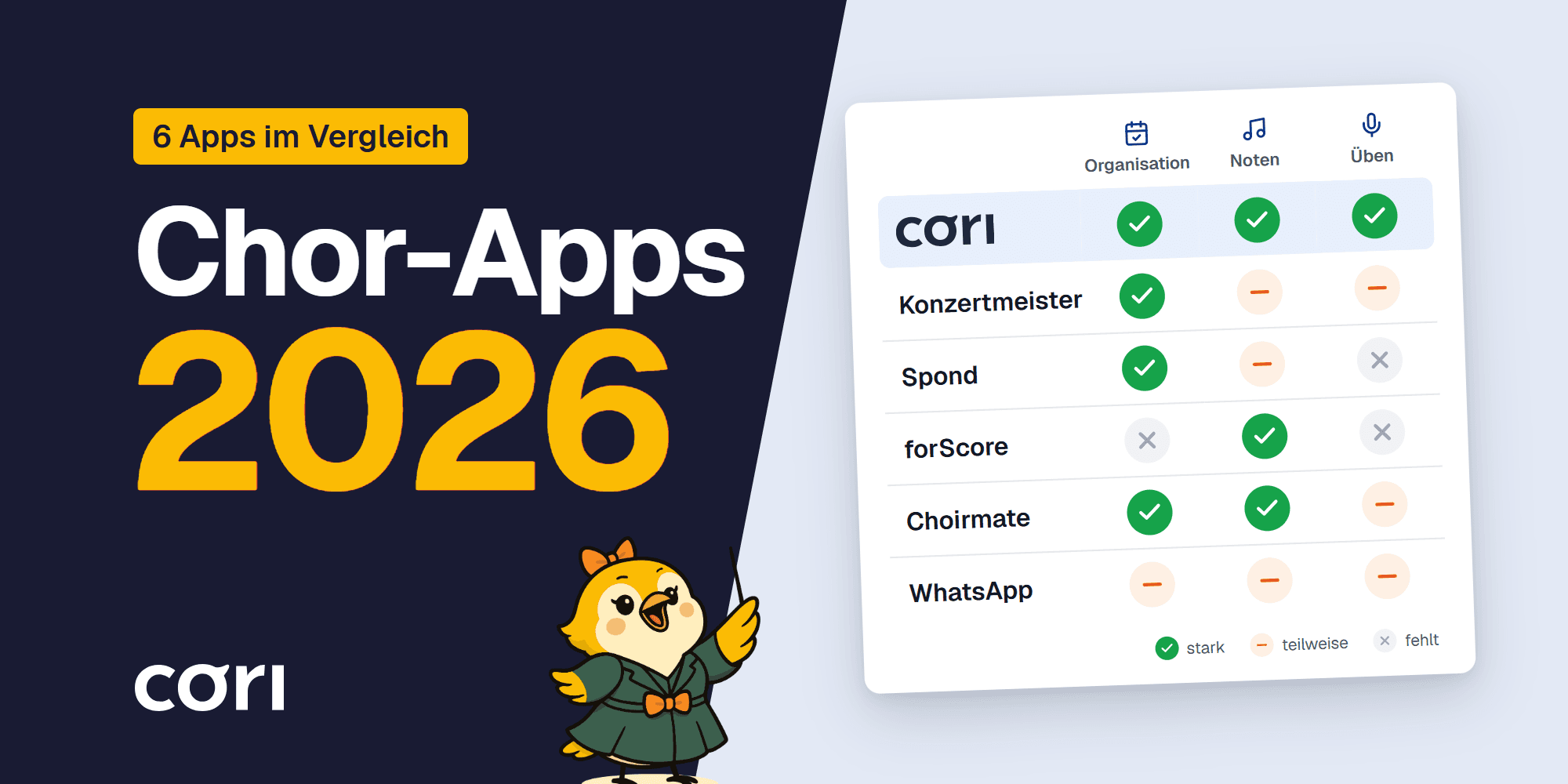
Choir Apps 2026 Compared
Seven choir apps compared for 2026: Konzertmeister, Spond, forScore, ChoirMate, Chorilo, cori and WhatsApp. What works for organization, and what for practice?